
Skip to content

How Caldolor Works

Mechanism of Action

Pain Happens Both Centrally and Peripherally21

Caldolor is a non-opioid IV NSAID that helps manage pain1:

Atom Streamline Plump

At the Nociceptors

Brain Streamline Lucide

By Crossing the Blood Brain Barrier

Rib Cage Fill Streamline Sharp Fill Streamline Material Free

At the Dorsal Horn

Caldolor produces analgesic, anti-inflammatory, and antipyretic effects through inhibition of the cyclooxygenase (COX) enzymes COX-1 and COX-2.1

Cyclooxygenase is the first enzyme in the biosynthesis pathway leading from arachidonic acid to prostaglandin G2 and prostaglandin H2, which are precursors of prostanoids that act as local mediators for peripheral pain and inflammation through the body.22

COX-1 is responsible for maintaining normal function in the gastrointestinal tract, platelets, and kidneys. COX-2 accounts for the anti-inflammatory and analgesic effects of NSAIDs.22

COX Inhibition Has
Three Major Effects22

Patches

Analgesic activity, i.e., blocking the initial inflammatory response to painful (noxious) stimuli

Antipiretic

Antipyretic activity

Stetoscopic

Anti-inflammatory activity

Woman Wheelchair

Dual COX Inhibition:
Balanced and Effective23,24
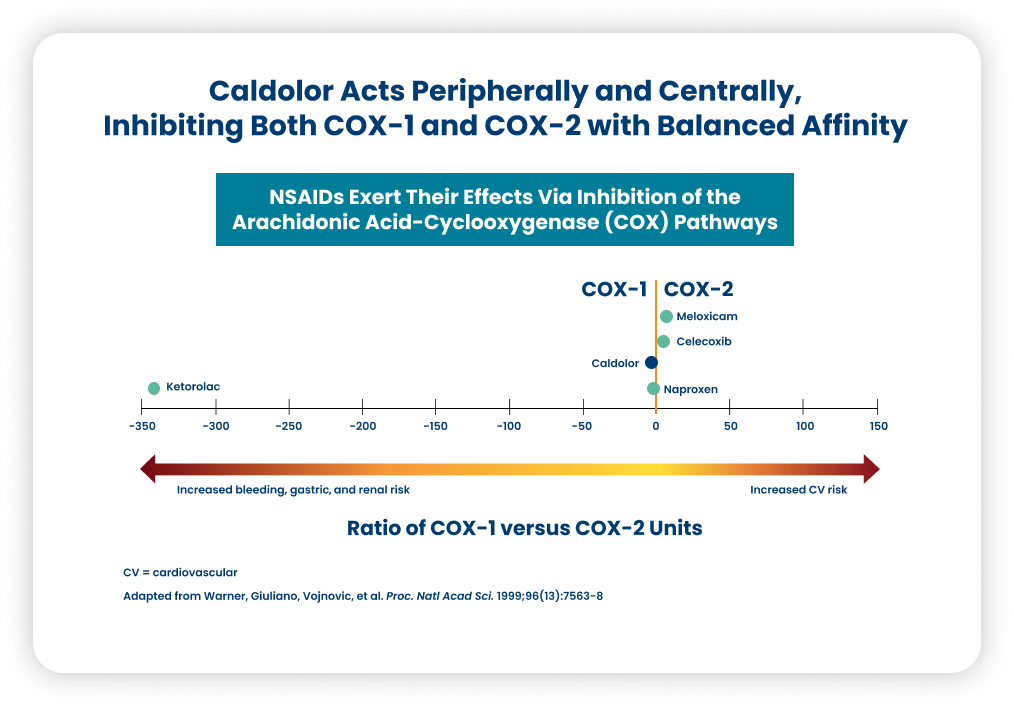
Chart Dual Cox
  • Not all NSAIDs are alike. Caldolor demonstrates a balanced selectivity profile between COX-1 and COX-2 inhibition.
    • COX-1 supports normal gastrointestinal (GI) protection, platelet aggregation, and renal function.
    • COX-2 is induced during inflammation and drives prostaglandin-mediated pain, swelling, and fever.
  • This balanced COX inhibition helps preserve GI and cardiovascular tolerability while maintaining analgesic and anti-inflammatory efficacy.

Pharmacokinetics25

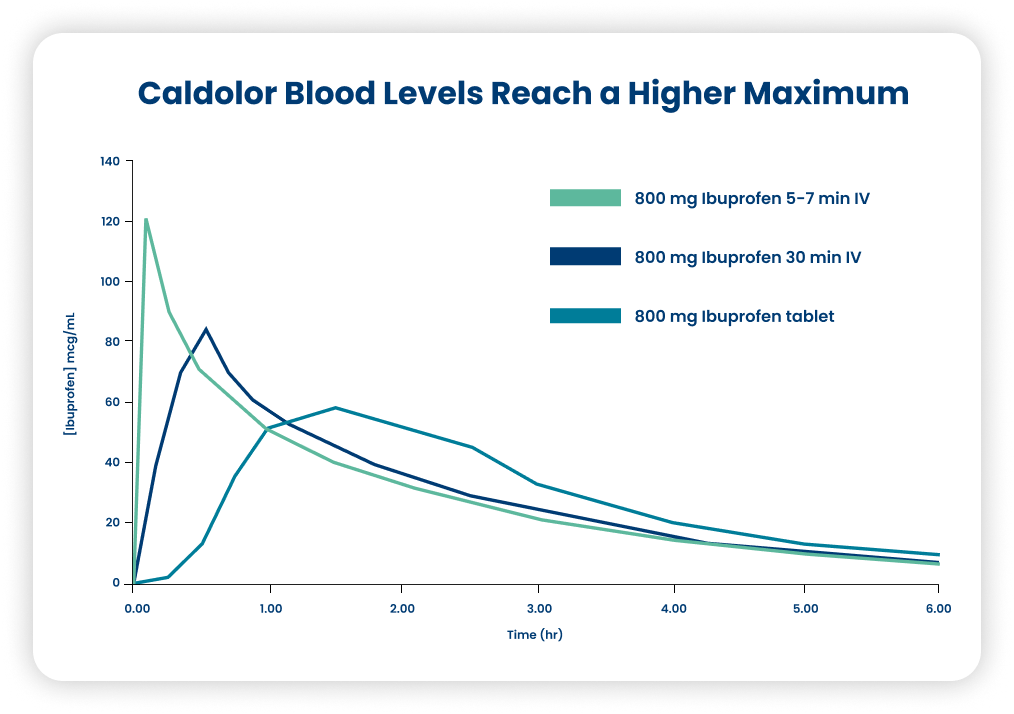
Caldolor delivers ibuprofen directly into the bloodstream, producing a rapid, predictable pharmacokinetic profile that supports effective acute pain and fever management.


Rapid Attainment of Peak Levels:

A 30-minute IV infusion achieves peak plasma concentration (Cmax) within approximately 30 minutes.


A 5-7 minute infusion achieves Cmax in about 6.5 minutes, providing a potential quicker onset of therapeutic effect while maintaining comparable total exposure.
Blood Level

Package Insert

Caldolor is a nonsteroidal anti-inflammatory drug indicated in adults and pediatric patients aged 3 months and older for the:

  • Management of mild to moderate pain, including postoperative pain
  • Management of moderate to severe pain, including postoperative pain, as an adjunct to opioid analgesics
  • Reduction of fever

This Product Includes the Following Boxed Warning:

Warning: Risk of Serious Cardiovascular and Gastrointestinal Events

Cardiovascular Thrombotic Events

  • Non-steroidal anti-inflammatory drugs (NSAIDs) cause an increased risk of serious cardiovascular thrombotic events, including myocardial infarction and stroke, which can be fatal. This risk may occur early in treatment and may increase with duration of use.
  • Caldolor is contraindicated in the setting of coronary artery bypass graft (CABG) surgery.

Gastrointestinal Bleeding, Ulceration and Perforation

  • NSAIDs cause an increased risk of serious gastrointestinal (GI) adverse events including bleeding, ulceration, and perforation of the stomach or intestines, which can be fatal. These events can occur at any time during use and without warning symptoms. Elderly patients and patients with a prior history of peptic ulcer disease and/or GI bleeding are at greater risk for serious GI events. 

Important Dosage and Administration Instructions

  • Caldolor Injection 800 mg/8 mL (100 mg/mL) vials must be diluted prior to administration.
  • Caldolor Injection 800 mg/200 mL (4 mg/mL) bags are ready to use.
  • Do not exceed 3,200 mg total daily dose in adults. Do not exceed 40 mg/kg or 2,400 mg, whichever is less, total daily dose in pediatric patients less than 17 years of age. In pediatric patients 3 months to less than 6 months of age, the dosage is limited to a single dose not to exceed 10 mg/kg or 100 mg, whichever is less.


Important Safety Information

Contraindications

  • Caldolor is contraindicated in patients with known hypersensitivity (e.g., anaphylactic reactions and serious skin reactions) to ibuprofen or any components of the drug product, and in patients who have a history of asthma, urticaria, or other allergic-type reactions after taking aspirin or other NSAIDs. Severe, sometimes fatal, anaphylactic reactions to NSAIDs have been reported in such patients. Caldolor is contraindicated in the setting of coronary artery bypass graft (CABG) surgery.


Warnings and Precautions

  • Use with caution in patients with known cardiovascular (CV) disease or risk factors for CV disease, a history of peptic ulcer disease and/or GI bleeding, renal or liver disease or symptoms of hypertension, and heart failure. Use the lowest effective dose for the shortest time period in these patients to reduce the risk of serious adverse events. Avoid use in pregnant women starting at 30 weeks gestation.


Adverse Reactions

  • The most common adverse reactions are nausea, flatulence, vomiting, headache, hemorrhage and dizziness (>5%). The most common adverse reactions in pediatric patients are infusion site pain, vomiting, nausea, anemia and headache (≥2%)

Have Questions or Would like to Stay Informed About Caldolor?

We’re Here to Help!

Contact Form Image