Skip to content

Dosing and Administration1

A Guide to Finding the Proper Dosing and Administration for Each Patient.

Who is Caldolor For?

Caldolor is the first and only IV NSAID approved for use in patients older than 3 months for the management of pain and fever.1

Adults

An injectable Caldolor for analgesia and fever for patients ages 18 and older.1

Pediatric

An injectable Caldolor for analgesia and fever in patients ages 3 months up to 17 years.1

Advantages for Patients

The Benefits of Caldolor

Heart Icon

Proven Pain and Fever Control1

Caldolor is indicated for the management of moderate to severe pain, including postoperative pain, as an adjunct to opioid analgesics and the reduction of fever.

Cross

Less Opioid-Use2,5

Caldolor has been proven to help reduce opioid use when treating mild to moderate and moderate to severe pain.

Insurance

Rapid-Reliable Relief41

In a head-to-head trial with ketorolac, Caldolor provided a more rapid response in treating acute pain caused by renal colic.

Cross Beat

Safe for Pediatrics and Adults1

Caldolor is safe for pediatric patients ages 3 months to 17 years and adult patients ages 18 and up.

DOSING & ADMINISTRATION - ADULTS1

For Analgesia (Pain): For Fever:
400 to 800 mg intravenously every 6 hours as necessary The dose is 400 mg intravenously, followed by 400 mg every 4 to 6 hours or 100 mg to 200 mg every 4 hours as necessary. Maximum daily dose is 3,200 mg.

In key clinical trials, Caldolor was infused over 30 minutes. Caldolor therapy has been initiated pre-, intra- and postoperatively in analgesic studies.2,3,4,16

Maximum daily dose is 3,200 mg

Vial must be diluted before administration

DOSING & ADMINISTRATION - PEDIATRICS1

For Analgesia (Pain) and Fever:
Age Group Dose Dosing Interval Min Infusion Time Max Daily Dose
3 months to less than 6 months 10 mg/kg up to 100 mg Single Dose 10 minutes 10 mg/kg or 100 mg, whichever is less
6 months to less than 12 years 10 mg/kg up to 400 mg Every 4 to 6 hours as necessary 10 minutes 40 mg/kg or 2,400 mg, whichever is less
12 years to 17 years 400 mg Every 4 to 6 hours 10 minutes 40 mg/kg or 2,400 mg, whichever is less

Pediatric patients received a single dose of 10 mg/kg (up to 600 mg) Caldolor at induction of anesthesia in a multicenter, randomized, double-blind study for treatment of pain associated with surgical tonsillectomy.3

Approved for patients 3 months and older

Vial must be diluted before administration

Caldolor Preparation
and Administration1

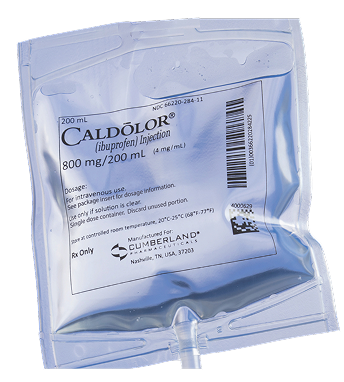
Pre-Mixed, Ready-to-Use Bag

Caldolor RTU Bag Transparent Background 2026 1
  • Caldolor injection 800 mg/200 mL (4 mg/mL) bags are ready-to-use and require no dilution prior to use. 
  • Diluent is an iso-osmotic phosphate buffer with an approximate pH of 7.4.

Vial Preparation
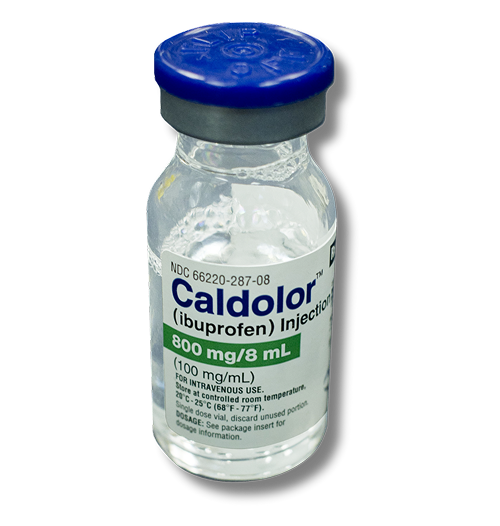
Caldolor Vial Transparent Background 2026 1
  • Caldolor injection is available in 800 mg/8 mL single-dose vials (100 mg/mL) with a 20 mm closure. Caldolor 800 mg/8 mL vials (100 mg/mL) must be diluted prior to intravenous infusion. Use without dilution can cause hemolysis. The Caldolor vials should not be given as an IV bolus or IM injections.
  • The stopper in the Caldolor vial is not made with natural rubber latex.
    Compatible diluents for the vial
    • 0.9% sodium chloride injection USP (normal saline)
    • 5% dextrose injection USP (D5W)
    • Lactated Ringer’s Solution
  • Dilute to a final concentration of 4 mg/mL or less.
    • 100 mg dose from the vial: Dilute 1 mL of Caldolor in at least 100 mL of diluent
    • 200 mg dose from the vial: Dilute 2 mL of Caldolor in at least 100 mL of diluent
    • 400 mg dose from the vial: Dilute 4 mL of Caldolor in at least 100 mL of diluent
    • 800 mg dose from the vial: Dilute 8 mL of Caldolor in at least 200 mL of diluent
  • For weight-based dosing at 10 mg/kg, ensure that the concentration of Caldolor is 4 mg/mL or less. 
  • To prepare an 800 mg dose using a needle-less transfer system with the Caldolor vial, Caldolor is compatible with the Vial2Bag® IV drug transfer system. Vial2Bag® is a registered trademark of Medimop Medical Project Ltd., a subsidiary of West Pharmaceutical Services, Inc.42 
  • Diluted solutions are stable for 7 days at refrigeration (2 to 8°C) or up to 24 hours at ambient (approximately 20-25°C) temperatures and lighting.43

Infusion Guidelines1

  • Use the lowest effective dosage for the shortest duration consistent with individual patient treatment goals.
  • After observing the response to initial therapy with Caldolor, the dose and frequency should be adjusted to suit an individual patient's needs. Do not exceed 3,200 mg total daily dose in adults. Do not exceed 40 mg/kg or 2,400 mg, whichever is less, total daily dose in pediatric patients 6 months to 17 years of age.
  • The dosage is limited to a single dose not to exceed 10 mg/kg or 100 mg, whichever is less, in pediatric patients 3 months to less than 6 months of age.
  • To reduce the risk of renal adverse reactions, patients must be well hydrated prior to administration of Caldolor.

Package Insert

Caldolor is a nonsteroidal anti-inflammatory drug indicated in adults and pediatric patients aged 3 months and older for the:

  • Management of mild to moderate pain, including postoperative pain
  • Management of moderate to severe pain, including postoperative pain, as an adjunct to opioid analgesics
  • Reduction of fever

This Product Includes the Following Boxed Warning:

Warning: Risk of Serious Cardiovascular and Gastrointestinal Events

Cardiovascular Thrombotic Events

  • Non-steroidal anti-inflammatory drugs (NSAIDs) cause an increased risk of serious cardiovascular thrombotic events, including myocardial infarction and stroke, which can be fatal. This risk may occur early in treatment and may increase with duration of use.
  • Caldolor is contraindicated in the setting of coronary artery bypass graft (CABG) surgery.

Gastrointestinal Bleeding, Ulceration and Perforation

  • NSAIDs cause an increased risk of serious gastrointestinal (GI) adverse events including bleeding, ulceration, and perforation of the stomach or intestines, which can be fatal. These events can occur at any time during use and without warning symptoms. Elderly patients and patients with a prior history of peptic ulcer disease and/or GI bleeding are at greater risk for serious GI events. 

Important Dosage and Administration Instructions

  • Caldolor Injection 800 mg/8 mL (100 mg/mL) vials must be diluted prior to administration.
  • Caldolor Injection 800 mg/200 mL (4 mg/mL) bags are ready to use.
  • Do not exceed 3,200 mg total daily dose in adults. Do not exceed 40 mg/kg or 2,400 mg, whichever is less, total daily dose in pediatric patients less than 17 years of age. In pediatric patients 3 months to less than 6 months of age, the dosage is limited to a single dose not to exceed 10 mg/kg or 100 mg, whichever is less.


Important Safety Information

Contraindications

  • Caldolor is contraindicated in patients with known hypersensitivity (e.g., anaphylactic reactions and serious skin reactions) to ibuprofen or any components of the drug product, and in patients who have a history of asthma, urticaria, or other allergic-type reactions after taking aspirin or other NSAIDs. Severe, sometimes fatal, anaphylactic reactions to NSAIDs have been reported in such patients. Caldolor is contraindicated in the setting of coronary artery bypass graft (CABG) surgery.


Warnings and Precautions

  • Use with caution in patients with known cardiovascular (CV) disease or risk factors for CV disease, a history of peptic ulcer disease and/or GI bleeding, renal or liver disease or symptoms of hypertension, and heart failure. Use the lowest effective dose for the shortest time period in these patients to reduce the risk of serious adverse events. Avoid use in pregnant women starting at 30 weeks gestation.


Adverse Reactions

  • The most common adverse reactions are nausea, flatulence, vomiting, headache, hemorrhage and dizziness (>5%). The most common adverse reactions in pediatric patients are infusion site pain, vomiting, nausea, anemia and headache (≥2%)

Have Questions or Would like to Stay Informed About Caldolor?

We’re Here to Help!

Contact Form Image